People aren't the problem. Their overloaded brain is.
Up-grade the human operator by unlocking people’s brain bandwidth. Stop the friction of misaligned effort, by exposing the illusion of productivity and supercharge strategic execution in today’s excessively loaded workplace.
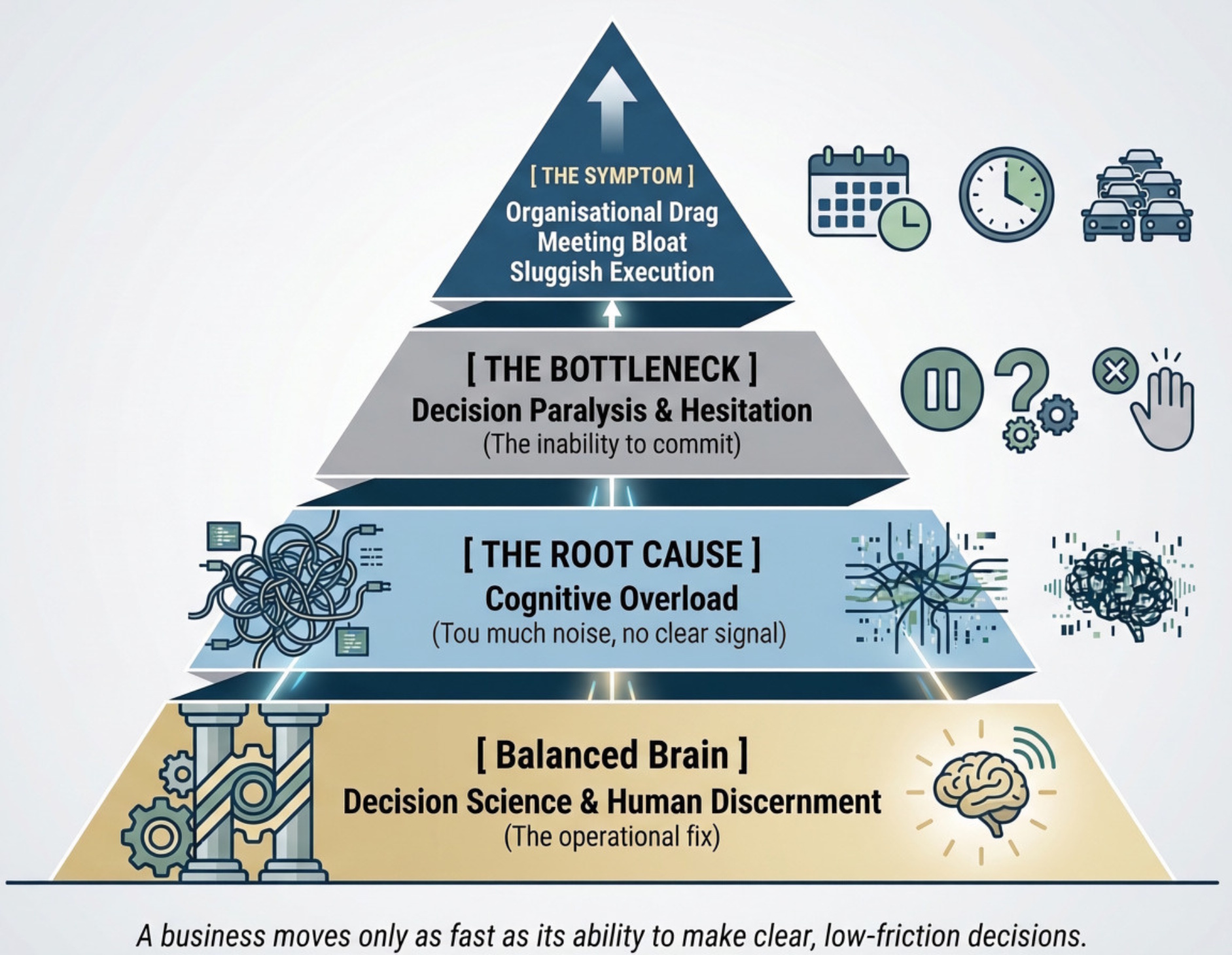
Strategy rarely fails on paper—it fails at the biological processing limit. When teams operate in chronic cognitive overload, they substitute reactive busyness for strategic momentum:
Misaligned Effort: Teams flat-out on low-value tasks rather than core priorities.
Execution Friction: Sluggish decisions and costly errors driven by mental fatigue.
Capacity Drain: Leadership bandwidth exhausted by firefighting instead of driving growth.
We solve this physiological bottleneck through a structured, three-stage operational intervention.
Diagnose
Expose the execution drag between Work-as-Imagined (business assumptions) and Work-as-Done (actual frontline reality).
Switch
Apply practical neuroscience reset methods to clear overload and restore decision bandwidth under pressure.
Track
Build sustainable operating habits across teams to secure long-term uptime and execution consistency.
/ About us
Decades of Research-backed Delivery in High-Stakes Environments
Diagnosing cognitive drag and embedding applied brain switches —slashed frontline incidents from 25+ down to 5 in 12 months.
1
Diagnostic Mapping
No generic playbooks. Our dual diagostic system indentifies the exact gap between Work-as-Imagined and Work-as-Done across your frontline workflows.
2
Applied Neuroscience
Translating biological cognitive capacity into field-tested tools that eliminate decision paralysis and micro-attentional drop-off.
3
Measurable Capacity Return
Replacing compliance theatre and execution drag with strategic output, mininimal errors, and rework; securing your reputation risk.
Building a deliberate STOP-and-discern step into the workflow at the exact point AI output is received, before it's acted on or passed downstream.
High Reliability Industries
Move beyond compliance theatre and paper-based processes to target frontline sensory lockouts, and attentional drop-offs before critical incidents occur.
Capacity and Strategy Execution
Close the hidden gap between executive strategy and frontline reality—eliminating tick-box compliance, busywork, and stalled execution.
/ TESTIMONIALS
Empirical Proof: Measurable Shifts in Operational Culture
Utlising the dual lens diagnotic to close the WAI versus WAD gap over three years of national benchmarking (Workers N=3000+; Managers N=350+) realigned our assumptions about good practice. Collectively we moved from 60% of managers blaming workers for procedural non-compliance to 50% actively identifying systemic friction and cognitive overload as the true root cause. This new level of behavioral discernment has transforme our frontline safety and execution culture, and radically reduced incidents.
UF National Benchmarking Program (15 Enterprise Partners)
Isolate the operational disconnect between Work-as-Imagined and Work-as-Done—revealing where perceived efficiency masks frontline friction, tick-box compliance, actual safety risks and performance drag.
Pinpoint the exact decision choke points, meeting bloat, and procedural overload stalling execution, allowing leadership to reclaim lost capacity and align strategy with frontline reality.
Equip operators with practical cognitive tools embedded directly into active shift routines to systematically clear operational overload and restore sharp execution under pressure.
Establish structural operational baselines to lock in high-performance workflows, backed by multi-year tracking to safeguard against operational drift.
The world is at a standstill because our mental highways are permanently jammed by the tech and AI deluge.
Global information infrastructure has outpaced human biology. Restore clarity, eliminate decision latency, and protect performance.





Utlising the dual lens diagnotic to close the WAI versus WAD gap over three years of national benchmarking (Workers N=3000+; Managers N=350+) realigned our assumptions about good practice. Collectively we moved from 60% of managers blaming workers for procedural non-compliance to 50% actively identifying systemic friction and cognitive overload as the true root cause. This new level of behavioral discernment has transforme our frontline safety and execution culture, and radically reduced incidents.